

หนึ่งในหัวใจสำคัญของ ข้อสอบ A Level อังกฤษ คือ Usage of English ที่ออกแบบมาเพื่อทดสอบว่าน้อง ๆ สามารถใช้ภาษาอังกฤษได้ถูกต้องทั้งในเชิงไวยากรณ์ (grammar) และการสื่อสารจริง (natural usage) หรือไม่ จุดนี้เองที่ทำให้ข้อสอบไม่ได้วัดแค่การจำโครงสร้างประโยค แต่ยังครอบคลุม collocations, idioms, inversion และ future expressions ที่เจ้าของภาษานิยมใช้จริงทั้งในชีวิตประจำวันและงานเขียนเชิงวิชาการ
การเข้าใจ Usage of English อย่างลึกซึ้ง จึงเปรียบเหมือนสะพานที่เชื่อมระหว่าง “ความรู้ grammar” กับ “การใช้ภาษาในสถานการณ์จริง” ซึ่งเป็นกุญแจสำคัญในการคว้าคะแนนเต็ม
บทความนี้จะพาน้อง ๆ ไปดู ตัวอย่างโจทย์ Usage of English ที่มักออกสอบจริง พร้อมเฉลยและคำอธิบายอย่างละเอียด เพื่อให้น้อง ๆ ทำข้อสอบได้อย่างมั่นใจและวางกลยุทธ์การติว A Level อังกฤษได้อย่างตรงจุด
Usage of English คืออะไร?
Usage of English คือทักษะการใช้ภาษาเชิงปฏิบัติ ไม่ใช่แค่รู้ความหมายของคำอย่างเดียว แต่รวมถึงรู้ว่าแต่ละคำหรือโครงสร้าง ใช้กับใคร/เมื่อไร/ในบริบทแบบไหน (context, collocation, grammar pattern, register, idiom, pragmatic meaning) ทำให้การเลือกคำหรือรูปประโยคถูกต้อง เหมาะสม และเป็นธรรมชาติ
Usage of English ในข้อสอบ A Level คืออะไร?
หลาย ๆ คนเวลาเจอข้อสอบ A Level English อาจจะบอกว่า “ทำด้วยเซนส์” แต่ความจริงแล้วเซนส์ที่ใช้ได้นั้นเกิดจาก สองปัจจัยสำคัญ
- เราเคยเห็นหรือจดจำโครงสร้างประโยคและการใช้คำแบบนั้นมาก่อน
- เราเข้าใจความหมายและการใช้งานจริง จึงเลือกคำตอบได้ถูกต้องตามบริบท
ดังนั้น “เซนส์ภาษาอังกฤษ” ไม่ใช่พรสวรรค์ติดตัว แต่เป็นสิ่งที่พัฒนาได้จากการฝึกฝนบ่อย ๆ ผ่านการอ่าน ฟัง และทำข้อสอบ Usage of English
Usage of English ในข้อสอบ A Level จึงหมายถึงการทดสอบว่า ผู้สอบสามารถใช้ภาษาได้ ถูกต้อง แม่นยำ และเป็นธรรมชาติ มากน้อยแค่ไหน โดยเน้นให้เลือกคำหรือโครงสร้างที่ใช้จริงในภาษาอังกฤษ
ตัวอย่างเช่น
- Collocations (การจับคู่คำที่เจ้าของภาษาใช้จริง)
✔️ make a decision ไม่ใช่ do a decision
✔️ get hurt ไม่ใช่ get hurting - Idioms และ fixed expressions
✔️ You’ve got to be kidding! = แสดงความไม่เชื่อ/ประหลาดใจ
❌ You must be joking แม้จะแปลถูก แต่ไม่เป็น idiom ที่เจ้าของภาษาชอบใช้ - Grammar structures เฉพาะทาง เช่น Inversion
✔️ Never have I seen such chaos.
❌ Never I have seen such chaos. - Future expressions (การบอกอนาคตหลายรูปแบบ)
✔️ The train is due to arrive at 6. = ตารางเวลาที่กำหนดแน่นอน
✔️ She is about to leave. = จะเกิดขึ้นในอีกไม่กี่นาที
✔️ They are on the verge of quitting. = ใกล้จะเกิดขึ้นเต็มที
กล่าวอีกอย่างหนึ่ง Usage of English คือการทดสอบว่าเราไม่ได้แค่ “รู้ grammar” แต่สามารถ เลือกใช้ภาษาให้ตรงตามความหมายและบริบท เหมือนเจ้าของภาษาใช้จริง ๆ และนี่เองที่ทำให้พาร์ตนี้ยากและแตกต่างจากข้อสอบทั่วไปค่ะ
องค์ประกอบสำคัญของ Usage of English (พร้อมตัวอย่างละเอียด)
1. Lexical meaning (ความหมายคำ)
คำที่มีหลายความหมาย ถ้าไม่ดูบริบทจะใช้ผิดบ่อยมาก เช่น get / run / miss / fine
Get
- I got a new phone yesterday. → get = obtain (ได้มา / ซื้อมา)
- I got sick after the trip. → get = become (กลายเป็น)
- I didn’t get your joke. → get = understand (เข้าใจ)
- I got my nails done. → get + obj + past participle = ให้คนอื่นทำให้ (causative)
- I got him a gift. → double object = ซื้อ/หาของให้ใคร (give/get sb sth)
Run
- She runs a company. → run = manage / บริหาร
- I run every morning. → run = jog / วิ่งออกกำลังกาย
- The contract runs for two years. → run = last / continue / มีระยะเวลา
- The river runs through the town. → run = flow / ไหลผ่าน
Miss
- I missed the train. → พลาดรถไฟ
- I miss my friends. → คิดถึง
- You missed the point. → เข้าใจประเด็นผิด
Fine
- I’m fine. → สบายดี
- The air is fine today. → อากาศดี
- He had to pay a fine. → ค่าปรับ
Make
- Make a decision → ตัดสินใจ
- Make a mistake → ทำผิด
- ❌ Do a decision → ผิด
Take
- Take a break → พัก
- Take medicine → ทานยา
- Take a photo → ถ่ายรูป
Do
- Do homework → ทำการบ้าน
- ❌ Make homework → ผิด
💡 เคล็ดลับ:
คำที่เหมือนกันแต่มี หลายความหมาย/หลาย collocation ต้องดู context / โครงสร้างรอบ ๆ เพื่อใช้ถูก ตัวอย่างเช่น get จะมีหลายรูปแบบ ทั้ง become / obtain / receive / understand / causative / double object
2. Collocation (คำที่มาคู่กัน)
การใช้ collocation ผิดเป็นสิ่งที่ออกบ่อยมาก เพราะ native speakers ใช้ “ความรู้สึก” ในการเลือกคำ
- ❌ do a mistake → ✔️ make a mistake
- ❌ strong rain → ✔️ heavy rain
- ❌ take a coffee → ✔️ have a coffee
3. Grammar patterns / Syntax
บางทีคำเดิม แต่ต้องใช้ โครงสร้าง ให้ถูก ไม่งั้นความหมายเปลี่ยน
- Causative with get/have
- I got my car washed. → ให้คนอื่นล้างรถให้ (ไม่ได้ล้างเอง)
- I washed my car. → ล้างเอง
- Double object
- I got him a gift. → ซื้อ/หาของขวัญให้เขา
- I got a gift for him. → อาจซื้อให้หรือได้รับแทนเขา
4. Fixed expressions & Idioms (วลีและสำนวนภาษาอังกฤษ)
คำที่ไม่สามารถแปลตรง ๆ ได้
- You’ve got to be kidding! → แสดงความไม่เชื่อ
- Under no circumstances should you open this door. → Inversion ใช้เพื่อเน้น
5. Register & Pragmatics (ระดับภาษา/ความสุภาพ)
คำเดิม แต่ระดับความสุภาพต่างกัน ทำให้เปลี่ยนบริบทได้
- Could you get me the report? → ขอแบบสุภาพ (workplace English)
- Get me the report! → คำสั่งตรง ๆ (ฟังดูห้วน/ไม่สุภาพ)
6. Meaning Nuance (ความแตกต่างของความหมายตามบริบท)
Future expressions ที่ออกสอบบ่อย
- be about to + V = กำลังจะเกิดขึ้นทันที/ใกล้จะเกิด (very imminent)
- be due to + V / be due (for sth) = มีกำหนด/ตามตาราง (scheduled/expected)
- be on the verge of / be on the point of = เกือบจะเกิด (formal/emphatic)
- be to + V = กำหนด/arranged (formal: official plan/command)
- be bound to / be sure to = แน่นอน/มีความเป็นไปได้สูง
เช่น
- She is about to cry. → จะเกิดขึ้นทันที (อีกไม่กี่วินาที)
- The train is due to arrive at 8. → เป็นตารางเวลาที่วางไว้
- He is on the verge of giving up. → ใกล้จะเกิดเต็มที (มีอารมณ์ร่วม/ดราม่า)
7. Transformations (การแปลงโครงสร้าง)
ความเข้าใจว่าประโยคเดียวกันเปลี่ยนได้หลายรูป
- Active → Passive
- They offered me a job. → I was offered a job.
- They offered me a job. → I was offered a job.
- Normal → Inversion
- I have never heard such a story. → Never have I heard such a story.
- I have never heard such a story. → Never have I heard such a story.
ตัวอย่าง “คำที่มักใช้ผิดเพราะความหมาย/บริบท”
- Actually
- คนไทยชอบใช้ว่า “actually = จริง ๆ แล้ว” แต่บางบริบทหมายถึง in fact / surprisingly
- Actually, I don’t like coffee. (พูดตรงข้ามที่คนคาดหวัง)
- Eventually
- ไม่ได้แปลว่า “ทันที” → แปลว่า “ในที่สุด”
- Eventually, she passed the exam after failing twice.
- Miss
- I missed the train. → พลาดรถไฟ
- I miss my friends. → คิดถึง
- You missed the point. → เข้าใจประเด็นผิด
- Fine
- I’m fine. → สบายดี
- The air is fine today. → อากาศดี
- He had to pay a fine. → ค่าปรับ
ตัวอย่างโจทย์ติว A Level อังกฤษ
ข้อ 1
Did you _______? (=become hurt) Choose TWO correct options
A. get hurt ✅
B. get an injury ✅
C. get injury
D. get hurting
เฉลย & อธิบาย:
- A. get hurt — ถูกที่สุดและเป็นธรรมชาติ: “Did you get hurt?” = “คุณเจ็บไหม?” (become hurt)
ตัวอย่าง: Did you get hurt playing football? - B. get an injury — ถูกได้ในความหมายว่า “ได้รับบาดเจ็บ / sustain an injury” แต่ต้องมี article เพราะ injury เป็นคำนามนับได้: “Did you get an injury?” (ฟังเป็นทางการกว่าเล็กน้อย)
- C. get injury — ผิด เพราะ injury เป็นคำนามนับได้ ต้องมี article (“an injury”) หรือเปลี่ยนเป็นพหูพจน์ “injuries”
- D. get hurting — ผิด เพราะรูป progressive ไม่ถูกกับความหมายนี้; ถ้าจะพูด “เริ่มเจ็บ” อาจใช้ “start hurting” แต่ “get hurting” ไม่เป็น collocation ปกติ
ข้อ 2
I _______ for her birthday. (=bought a ring for my wife)
A. got my wife a ring ✅
B. ’ve got my wife to a ring
C. got to my wife a ring
D. got a ring my wife
เฉลย & อธิบาย:
- A. got my wife a ring — ถูก: รูป double object (get/give/buy + person + thing). เทียบกับ “I bought my wife a ring.”
ตัวอย่าง: I got my wife a ring for her birthday. - B–D — ผิด เพราะคำสั่งวางผิด, ขาด preposition หรือใช้โครงสร้างผิด (“to” ถูกใช้กับบางกรณีแต่ไม่ในตำแหน่งนี้)
ข้อ 3
You _______ kidding. (=must be joking/can’t be serious)
A. get to be
B. get to
C. must get to be
D. ’ve got to be ✅
เฉลย & อธิบาย:
- D. ’ve got to be (You’ve got to be kidding) — นิยมมากในอังกฤษ/อเมริกา = “You must be joking.”
ข้ออื่นผิดเพราะไม่ใช่ idiom ที่ถูกต้อง
ข้อ 4
What time will you _______? (=arrive)
A. get to here
B. get to be here
C. get here ✅
D. ’ve got here
เฉลย & อธิบาย:
- C. get here — “get here” = arrive (ตรงที่สุด)
- A. get to here — ซ้ำซ้อนและไม่ธรรมชาติ (ถูกคือ get here หรือ get to (a place) เช่น get to the station)
- D. ’ve got here — รูป present perfect ไม่เข้ากับคำถามอนาคต “What time will you …?”
ข้อ 5
You should _______. (=pay someone to do your nails)
A. get someone do your nails
B. get your nails
C. get to do your nails
D. get your nails done ✅
เฉลย & อธิบาย:
- D. get your nails done — ตัวอย่างของ causative: get + object + past participle = จ้าง/ให้ใครทำให้ เช่น get your hair cut, get your car repaired.
- A. get someone do — ผิด ต้องเป็น get someone to do (make sb do sth) แต่ถ้าจะพูดว่า “ให้ช่างทำเล็บ” ใช้ get your nails done
- B, C — ไม่ถูกรูป
ข้อ 6
Can you _______, please? (=bring)
A. get to bring the sugar
B. get to the sugar
C. get bringing the sugar
D. get me the sugar ✅
เฉลย & อธิบาย:
- D. get me the sugar — ประโยคขอร้องแบบไม่เป็นทางการ: “Could you get me the sugar, please?” = “ช่วยนำ/หยิบซักหน่อย”
- อื่นๆ เป็นรูปที่ไม่ถูกต้อง/ไม่ธรรมชาติ
ข้อ 7
I can’t _______ still at the dinner table. (=make my child sit)
A. get my child to sit ✅
B. get to sit my child
C. get sitting my child
D. get my child sit
เฉลย & อธิบาย:
- A. get my child to sit — รูป get + object + to-infinitive = ทำให้ใครทำอะไร (causative)
ตัวอย่าง: I can’t get my child to sit still at the dinner table. - D. get my child sit — ผิด เพราะต้องเป็น to sit
ข้อ 8
I _______. Could you be more specific? (=understand you)
A. didn’t get to you
B. didn’t get understand you
C. didn’t get you ✅
D. didn’t got you
เฉลย & อธิบาย:
- C. didn’t get you — “I didn’t get you” = “ผม/ฉันไม่เข้าใจคุณ” (ใช้อธิบายว่าไม่เข้าใจข้อความ/คำพูด)
- A. didn’t get to you — อาจหมายว่า “ไม่ถึงคุณ” (เช่น message didn’t reach you) แต่ในบริบท “Could you be more specific?” คำตอบที่ต้องการคือ “I didn’t get you (I don’t understand you).”
- D. didn’t got you — ผิดไวยากรณ์
ข้อ 9
Can you help me _______ the room upstairs? (=move)
A. get this sofa to ✅
B. get this sofa
C. ’ve got this sofa to
D. get moving this sofa to
เฉลย & อธิบาย:
- A. get this sofa to — ประโยคเต็ม: Can you help me get this sofa to the room upstairs? → “ช่วยเอาฟูก้า/โซฟาไปที่ห้องชั้นบนหน่อยได้ไหม?” รูปแบบ: get [object] to [place] = move sth to somewhere.
- B. get this sofa — ไม่สมบูรณ์ ต้องมีทิศทาง/ตำแหน่งต่อท้าย (“to the room upstairs”)
- D. get moving this sofa to — รูปผิด/ไม่เป็นธรรมชาติ
ข้อ 10
I _______ a year in my new job. (=receive/earn money)
A. ’ve got £22,000 ✅ (ยอมรับได้)
B. get £22,000 ✅ (ยอมรับได้)
C. get to earning
D. get earning
เฉลย & อธิบาย:
- ทั้ง A และ B สามารถใช้ได้ ขึ้นกับรูปแบบที่ต้องการ:
- I get £22,000 a year in my new job. (present simple = รายได้ปกติต่อปี)
- I’ve got £22,000 a year. (have got = informal present = “มี/ได้รับ” ในความหมายเงินเดือน)
- C, D — รูปผิด/ไม่ธรรมชาติ
ข้อ 11
Did you _______? (= receive)
A. get received my message
B. get my message ✅
C. get receiveing my message
D. get my message received
เฉลย & อธิบาย:
- B. get my message — Did you get my message? = “คุณได้รับข้อความผม/ฉันไหม?” (ธรรมดาและถูกต้อง)
- A/C/D — ผิดรูป
ข้อ 12
We _______ last night. (=passive sense; someone burgled us)
A. got burgled ✅
B. got to be burgled
C. were get burgled
D. got to burgled
เฉลย & อธิบาย:
- A. got burgled — บอกเหตุการณ์ในรูป passive: “พวกเราถูกขโมย/โดนลักเมื่อคืน” (สำนวน: get + past participle ใช้แทน passive อย่างไม่เป็นทางการ)
- ตัวเลือกอื่นผิดไวยากรณ์หรือไม่เป็น collocation
ข้อ 13
_______ started the discussion _______ a group of hooligans arrived and started shouting slogans.
A. Barely had they / when ✅
B. No sooner had they / when
C. Barely they had / when
D. No sooner had they / that
เฉลย & อธิบาย:
- A. Barely had they / when — รูปที่ถูกคือ Barely had they started the discussion when a group of hooligans arrived… (“ทันใดนั้น / แทบจะไม่ทัน…”)
- B ผิดเพราะถ้าจะใช้ No sooner ควรใช้คู่กับ than ไม่ใช่ when (มาตรฐานคือ No sooner had they… than…).
- C ไวยากรณ์ผิด
- D No sooner had they / that — มักเป็น than ไม่ใช่ that (บางสำเนียงเก่าอาจใช้ when/that แต่แบบมาตรฐานใช้ than)
ข้อ 14
_______ we take specific actions immediately _______ hope to stop climate change in some way.
A. Rarely when / can we
B. If only / can we
C. Only if / can we ✅
D. Only / we can
เฉลย & อธิบาย:
- C. Only if / can we — รูป Only if + condition, auxiliary + subject + main verb = inversion หลัง Only if เมื่ออยู่ในตำแหน่งนำ เช่น Only if we take action now can we hope to stop climate change.
- B. If only แปลต่างกัน (“ถ้าหวัง/อยากให้…”) และตามด้วย inversion แบบนี้ไม่ถูก
- D. ไวยากรณ์ผิด/ไม่ inverted
ข้อ 15
______ break the law, _______ put themselves and others in unnecessary danger.
A. Not only they / but they also
B. Not only have they / but they also have
C. Not only did they / but did they also
D. Not only did they / but they also ✅
เฉลย & อธิบาย:
- D. Not only did they / but they also — เมื่อต้องการเน้นว่าทำสองสิ่ง ใช้ Not only + auxiliary + subject (inversion) และส่วนที่สองตามด้วยโครงสร้างปกติ: Not only did they break the law, but they also put themselves and others in unnecessary danger.
- C ผิดเพราะในส่วนที่สองไม่ต้อง inversion และคำว่า did they also ไม่เป็นธรรมชาติที่นี่
- B รูปซับซ้อนและไม่ตรงกับเวลานี้
ข้อ 16
_______ allow such terrible actions to happen again.
A. Never again we will
B. No way will
C. Under no circumstances will we ✅
D. Little will we
เฉลย & อธิบาย:
- C. Under no circumstances will we — รูปแบบมาตรฐาน: Under no circumstances will we allow such terrible actions to happen again. (formal + strong)
- B No way will ไม่สมบูรณ์ (ต้องตามด้วย subject+verb: No way will we … — อาจได้แต่ไม่ธรรมชาติเท่า C)
- D Little will we แปลต่างกัน (หมายถึง “เราแทบจะไม่ …”)
ข้อ 17
We all need to be on sensible alert, but _______ allow fear to dictate the course of our lives.
A. never we must
B. on no account should we ✅
C. no way we should
D. under no circumstances we should
เฉลย & อธิบาย:
- B. on no account should we — เป็น inversion กับ on no account = “ในกรณีใด ๆ ก็ไม่ควร” → On no account should we allow fear to dictate…
- D รูปคำผิดลำดับ (ต้อง invert: Under no circumstances should we …)
ข้อ 18
_______ Jacqueline Kennedy _______ a first lady as charming, glamorous, or inspirational.
A. Never / was there
B. Never / there was
C. Not since / there has been
D. Not since / has there been ✅
เฉลย & อธิบาย:
- D. Not since / has there been — ใช้ Not since + time/event, auxiliary + subject + main verb เช่น Not since Jacqueline Kennedy has there been a first lady as charming… = “ตั้งแต่ Jacqueline Kennedy ยังไม่มีใครเป็นแบบนี้อีก”
- A/B รูปไม่ตรงกับ inversion pattern ที่ต้องการเมื่อเริ่มด้วย Never/Not since
ข้อ 19
Very _______ see that type of heroism again.
A. rarely will people ✅
B. never will people
C. rarely people will
D. little people will
เฉลย & อธิบาย:
- A. rarely will people — Rarely will people see that type of heroism again. (inversion with rarely)
- C ไวยากรณ์ผิดลำดับ
ข้อ 20
_______ know how widely diffused his tweet would become.
A. Little he
B. Little he did
C. Little did he ✅
D. Little he has
เฉลย & อธิบาย:
- C. Little did he — Little did he know how widely diffused his tweet would become. (inversion with little)
ข้อ 21
_______ more vulnerable _______ when we are beginning to fall in love.
A. Nowhere we are / that
B. Nowhere are we / than ✅
C. Nowhere we are / as
D. Nowhere are we / that
เฉลย & อธิบาย:
- B. Nowhere are we / than — Nowhere are we more vulnerable than when we are beginning to fall in love. (inversion + comparison)
- ต้องใช้ than กับ comparison
ข้อ 22
_______ refuse an offer like that!
A. Under no circumstances I’ll
B. No way am I going to ✅
C. Never again I’m going to
D. Seldom am I
เฉลย & อธิบาย:
- B. No way am I going to — “ไม่นะ/ไม่มีทางฉันจะปฏิเสธข้อเสนอแบบนั้น” (informal emphasis)
- A/C รูปผิดไวยากรณ์; D แปลต่างกัน
ข้อ 23
The government ______ to pass the new law by the end of the year.
A. is about
B. is on the verge
C. is
D. is on the point ✅ (แต่ต้องเข้าใจว่า idiom เต็มคือ is on the point of )
เฉลย & อธิบาย:
- D ถูกที่สุดในตัวเลือก เพราะ on the point (full phrase on the point of) = ใกล้จะทำ/กำลังจะทำ อย่างไรก็ตามรูปที่สมบูรณ์และธรรมชาติคือ The government is on the point of passing the new law…
- ถ้ามีตัวเลือก is due to หรือ is due จะเป็นตัวเลือกที่เหมาะถ้าหมายถึง “มีกำหนด/คาดว่าจะ” แต่ในชุดนี้ D เหมาะสุด
ข้อ 24
The new canal ______ to be finished by December next year.
A. is due ✅
B. is on the brink
C. is about
D. is on the verge
เฉลย & อธิบาย:
- A. is due — is due to be finished/by = มีเส้นตาย/มีกำหนดคาดว่าจะเสร็จ (scheduled)
- D (is on the verge) ก็สื่อว่า “ใกล้จะเสร็จ” แต่ is due เหมาะสำหรับกำหนดเวลา
ข้อ 25
Researchers say they are ______ discovering a new form of life.
A. about
B. on the verge of ✅
C. on the point of ✅
D. on the point of / on the verge of ✅
เฉลย & อธิบาย:
- B/C/D — ทั้ง on the verge of และ on the point of ถูก: แปลว่า “พวกเขาใกล้จะค้นพบ” (imminent) — D ครอบคลุมทั้งสองรูป
ข้อ 26
She is ______ to give birth to their second child in a few weeks.
A. sure
B. on the verge
C. about
D. due ✅
เฉลย & อธิบาย:
- D. due — She is due to give birth in a few weeks. = มีกำหนดจะคลอด/เป็นเวลาที่คาดว่าจะคลอด
ข้อ 27
The National Institute of Health ______ to begin the first human trials for an experimental vaccine in the coming months.
A. is on the verge
B. is due ✅
C. is about
D. is on the point
เฉลย & อธิบาย:
- B. is due — ใช้ในบริบทที่เป็นการประกาศ/กำหนดการ: is due to begin = มีกำหนดจะเริ่ม
ข้อ 28
The prime minister ______ contact the French president to begin negotiations.
A. is on the verge
B. is on the brink
C. is due
D. is to ✅
เฉลย & อธิบาย:
- D. is to — is to + V ใช้ในภาษาทางการเมื่อบอกถึงแผน/การจัดเตรียมอย่างเป็นทางการ: The prime minister is to contact the French president. (formal)
ข้อ 29
Borneo’s orangutans are ______ extinct.
A. on the verge of becoming ✅
B. about to become ✅
C. due to become
D. on the verge of becoming / about to become ✅
เฉลย & อธิบาย:
- A / B / D — on the verge of becoming และ about to become ทั้งคู่ถูก (แปลว่า “ใกล้จะสูญพันธุ์”)
- C (due to become) ไม่ค่อยธรรมชาติในบริบทนี้ — due to มักหมายถึง “ตามกำหนด” ไม่ใช่ความหมายเชิงชะตากรรม
ข้อ 30
The next generation of the device ______ to be unveiled until October 4th.
A. isn’t due ✅
B. isn’t unlikely
C. isn’t about
D. isn’t on the verge
เฉลย & อธิบาย:
- A. isn’t due — ประโยคเต็มมักจะเป็น The next generation of the device isn’t due to be unveiled until October 4th. = “ยังไม่มีกำหนด/ไม่คาดว่าจะเปิดตัวจนกว่าจะถึง 4 ต.ค.”
- ตัวเลือกอื่นไม่เป็นธรรมชาติ
ข้อ 31
Experts say the terrorist attack ______ to affect tourism in the short term.
A. is on the point
B. is due
C. is bound ✅
D. is about
เฉลย & อธิบาย:
- C. is bound — is bound to = น่าจะ/คาดว่าจะ (มีความเป็นไปได้สูง) — is bound ในตัวเลือกนี้คาดว่ามี to ต่อท้ายในประโยคจริง: is bound to affect tourism
- B (is due) แปลว่ามีการนัด/มีกำหนด — ไม่ตรงความหมาย
- A/D ไม่ธรรมชาติในบริบทนี้
ข้อ 32
The government ______ its decision at a press conference on Friday.
A. is about to announce
B. is unlikely to announce
C. is on the verge of announcing
D. is due to announce ✅ (แต่ A ก็เป็นไปได้ขึ้นกับนัย)
เฉลย & อธิบาย:
- D. is due to announce — ถ้ามีแผน/กำหนดเวลา/นัดหมายแล้ว: The government is due to announce its decision at a press conference on Friday. (เหมาะเมื่อมีการนัดหมาย)
- A. is about to announce — เหมาะถ้าประกาศจะเกิดขึ้นทันทีในช่วงใกล้ ๆ (imminent). ทั้งสองจึงเป็นไปได้ แต่ถ้าระบุ “on Friday” (มีวันที่) is due to announce เหมาะกว่าในความหมายของกำหนดการ
สรุป Tips ทำยังไงให้เก่ง Usage of English ติวโค้งสุดท้ายก่อนสอบ
- จำรูปแบบ collocation เป็นวลี ไม่ใช่คำเดี่ยว
- เช่น get hurt, get an injury, get someone to do sth, get sth done จดเป็นประโยคตัวอย่างแล้วทวนบ่อยๆ
- ฝึกแยกความหมายของคำที่มีหลายความหมาย (polysemy) โดยมอง context
- get + noun/place/time → อาจหมาย arrive/get to / receive / become / earn / cause
- ฝึก inversion จากประโยคข่าว/บทความ คัดประโยค Never…, Not only…, Under no circumstances…, Little did… มาแปลงและทำความเข้าใจ
- แยก future expressions ตามระดับความใกล้/ความแน่นอน (about to = เกิดทันที / due to = มีกำหนด / on the verge of = เกือบจะ / is to = arranged / is bound to = very likely)
- ทำข้อสอบแบบจับเวลา แล้วอธิบายเหตุผลทุกข้อ การอธิบายเหตุผลจะช่วยให้เข้าใจ pattern แทนการท่องตอบอย่างเดียว
- ทำ sheet รวม collocations/idioms/structures ที่พบบ่อย เก็บไว้ทบทวนก่อนสอบ
ติว A Level อังกฤษ ที่ไหนดี?
เวลาตัดสินใจเลือกคอร์ส ควรดูว่า
✅ ครอบคลุมทุกพาร์ต
✅ มี Mock Test พร้อมเฉลยละเอียด
✅ สอนเทคนิคจับเวลา + ตัดตัวเลือกเร็ว
✅ มี Feedback การเขียน Essay
แนะนำคอร์ส A Level อังกฤษ
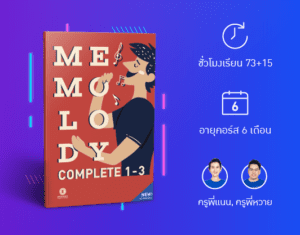
คอร์สนี้เหมาะกับน้อง ๆ ที่อยากพัฒนาศัพท์และสำนวนภาษาอังกฤษอย่างครบถ้วน พร้อม สกิลทำข้อสอบ A Level ทุกพาร์ต
คอร์สที่มีการเจาะลึกในเรื่องศัพท์และสำนวน พร้อมช่วยพัฒนาสกิลเพื่อไปใช้ทำข้อสอบ A Level ครบทุกพาร์ต ที่ขึ้นชื่อเรื่องความท้าทายในการทำข้อสอบให้ทันเวลา ให้น้อง ๆ ได้ฝึกทำโจทย์ ตะลุยโจทย์ข้อสอบเก่า ทำข้อสอบเสมือนจริง และ มีเวลาจำกัดให้ฟีลเหมือนกำลังเข้าไปสอบจริง ๆ เพื่อกำจัดจุดอ่อนที่น้อง ๆ ยังไม่แม่น หรือรู้สึกไม่มั่นใจ อีกทั้งยังมีการแตกศัพท์เยอะมาก ให้น้อง ๆ ได้มีคลังคำศัพท์ไว้ใช้สอบ
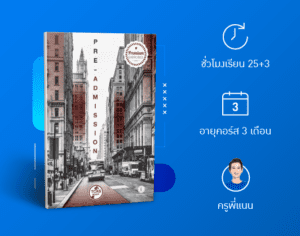
Pre TCAS Admission อังกฤษ
คอร์สที่เน้นเรียนเนื้อหามากกว่าการทำโจทย์ ช่วยทบทวนเนื้อหาทั้งแกรมมาร์ คำศัพท์ และพาร์ต Reading ที่มักออกสอบในข้อสอบส่วนกลาง เช่น TGAT และ A Level และเทคนิคเพิ่มคลังคำศัพท์ ด้วยเพลง Memolody กว่า 40 เพลง ช่วยปูพื้นฐานให้แน่น และสอนแกรมมาร์ด้วยเทคนิคคิดเป็นภาพแบบ Tree Tactics ฝึกฝนทำโจทย์ กว่า 500 ข้อ
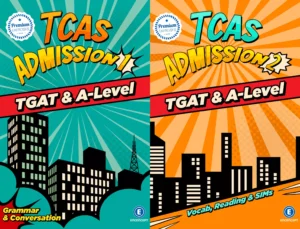
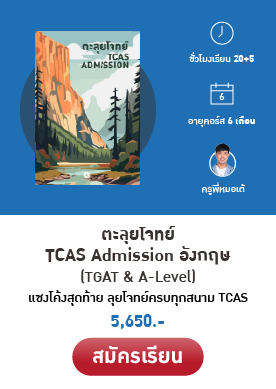
TCAS Admission อังกฤษ (TGAT, A Level)
คอร์ส TCAS Admission อังกฤษ TGAT, A Level) ซึ่งเป็นคอร์สที่มีทั้ง TGAT ENG และ A Level อังกฤษ ที่ได้สรุปเนื้อหาที่ออกสอบบ่อย พร้อมข้อสอบที่ออกสอบจริงมาให้ฝึกทำ เรียงลำดับจากง่ายไปยาก จัดเต็มไปด้วยเนื้อหาที่ครอบคลุมทุกการสอบภาษาอังกฤษ ไม่ว่าจะเป็น ด้านคำศัพท์ แกรมมาร์ การอ่าน และกลอนเพื่อให้จำได้ดียิ่งขึ้น พร้อมฝึกฝนทำโจทย์จริงกว่า 800 ข้อ
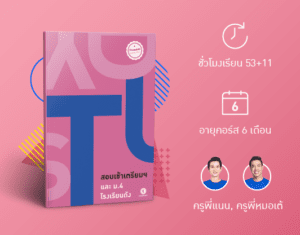
ตะลุยโจทย์ TCAS Admission อังกฤษ
คอร์สตะลุยโจทย์ข้อสอบ TGAT & A Level ที่มาพร้อมกับเทคนิคทำโจทย์ ใหน้องๆ ที่ต้องการลุยทำข้อสอบแบบครบทุกสนาม เน้นให้คล่อง และเสร็จทันเวลา ด้วยโจทย์กว่า 300 ข้อ
รายละเอียดเพิ่มเติมสามารถสอบถามได้ที่ ENCONCEPT ทุกสาขา เช็กสาขาใกล้บ้าน ได้ที่นี่



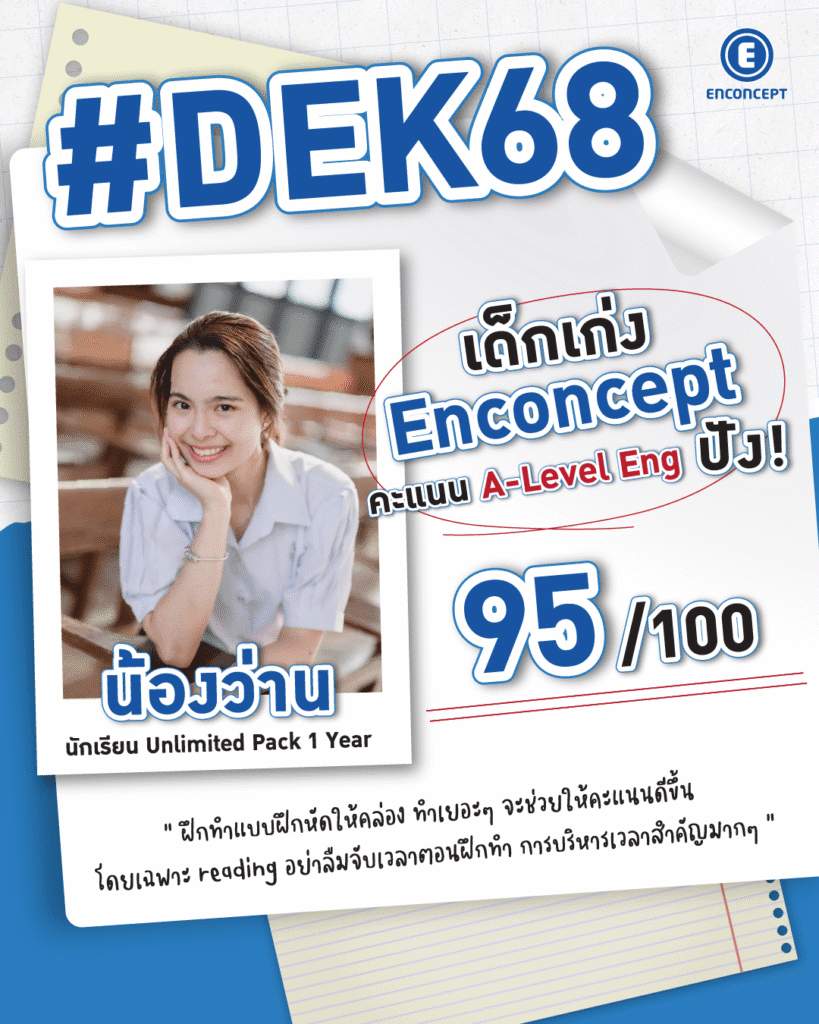
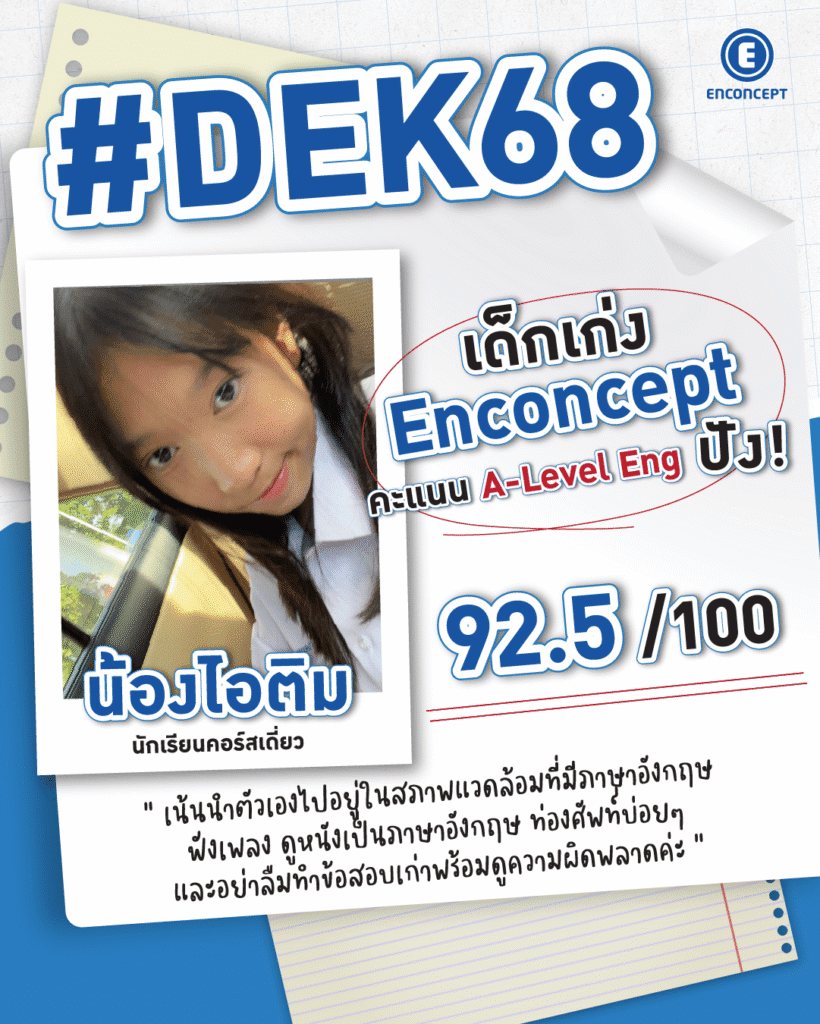
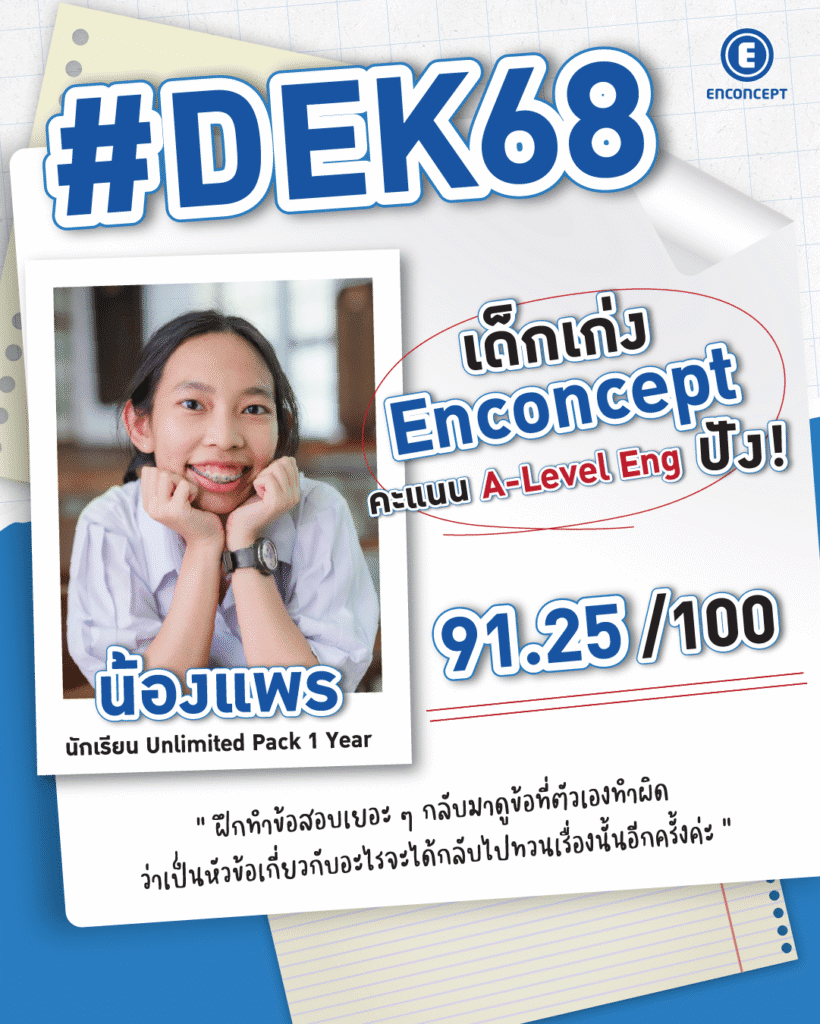
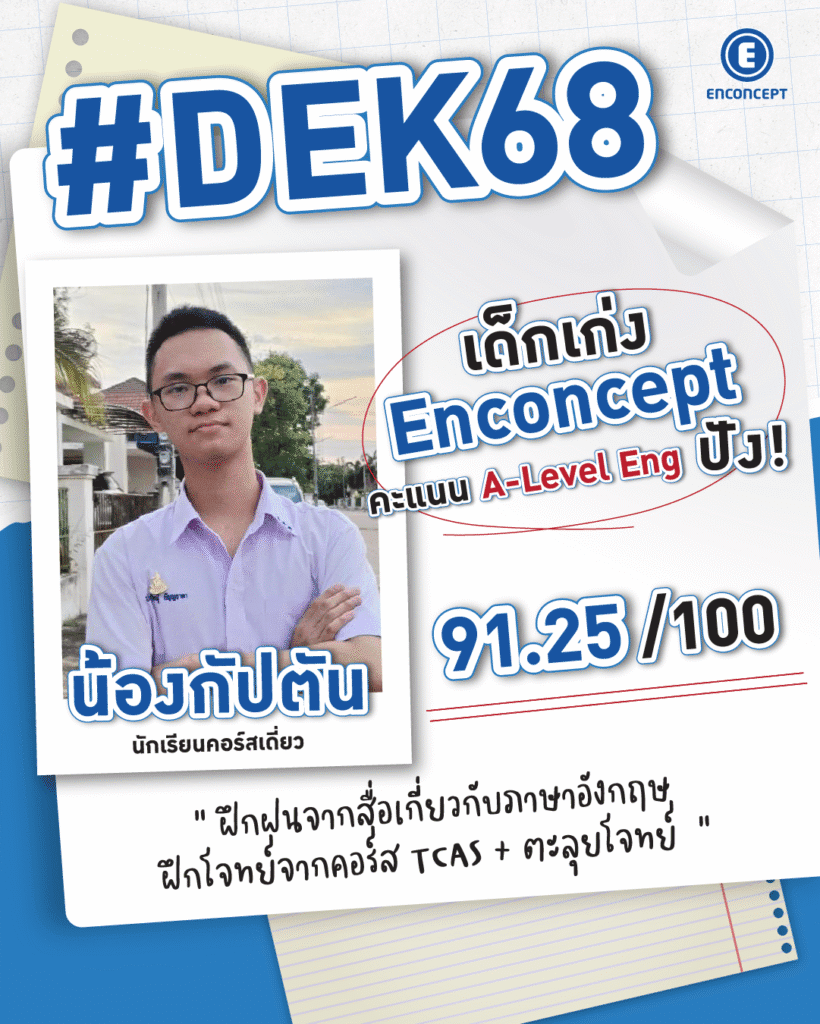
Review จากรุ่นพี่ที่ได้ A Level อังกฤษ 90+